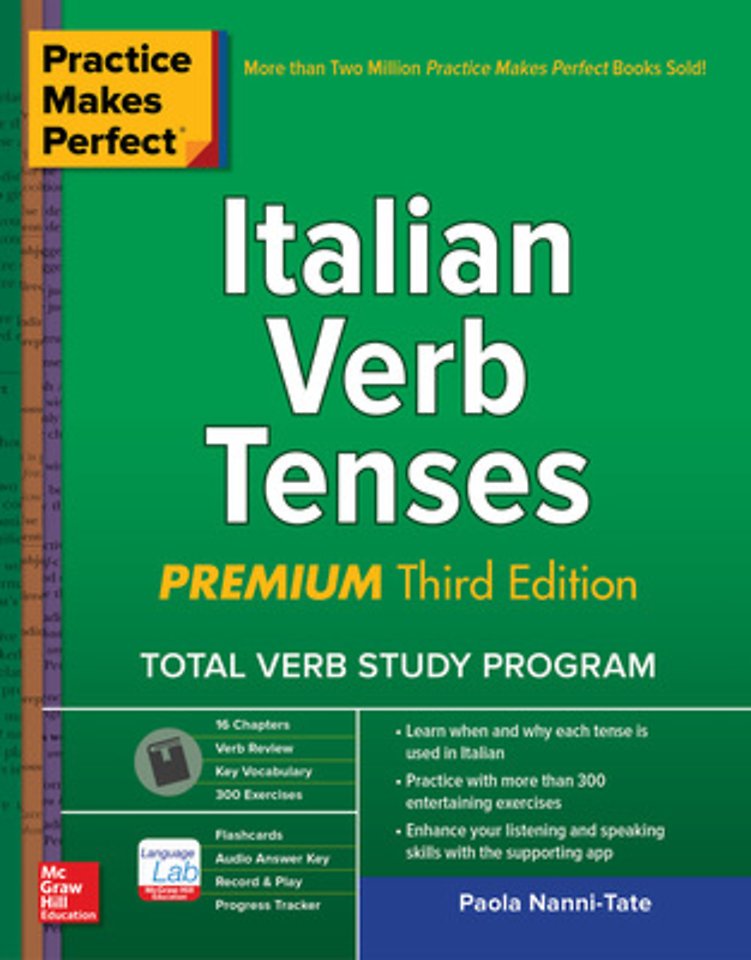
Practice Makes Perfect: Italian Verb Tenses, Premium Third Edition

Paperback Engels 2019 3e druk 9781260453430
Levertijd ongeveer 11 werkdagen
Gratis verzonden

Samenvatting

Go beyond conjugation to master Italian verbs and their usage
Verbs play a vitally important role in every sentence, and the selection of a particular verb and a specific tense has a great impact on meaning. To help you understand why a certain tense works in a given situation, Practice Makes Perfect: Italian Verb Tenses provides clear, concise explanations, combined with plenty of practice to develop language skills. And this new edition is accompanied by audio recordings, available online and via app, that will build greater confidence in your ability to communicate.
Practice Makes Perfect: Italian Verb Tenses will help you:● Build your verb skills using more than 200 engaging exercises● Learn when and why to use each verb tense in Italian● Reinforce your knowledge with everyday example sentences● Improve your listening and pronunciation skills● Study on-the-go with recordings and review quizzes via app
THE BONUS APP THAT ACCOMPANIES THIS BOOK PROVIDES:STREAMING AUDIO of most exercise answers to model your pronunciation after native speakersFLASHCARDS to aid memorization of all vocabulary termsQUIZZES to review your understanding on-the-goAUTO-FILL GLOSSARY for quick reference

Specificaties

ISBN13:9781260453430
Taal:Engels
Bindwijze:paperback
Druk:3

Lezersrecensies

Wees de eerste die een lezersrecensie schrijft!

Inhoudsopgave

<p><span>Introduction<br>Basic Terminology</span></p><p></p><p></p><p>Unit 1: The Present Tense (Presente Indicativo)<br>Verbs Ending in -are<br>Verbs Ending in -ere<br>Verbs Ending in -ire<br>The Progressive Tense (Gerundio)<br>Essere (to Be) and Avere (to Have)<br>Expressions of Time<br>Fare (to Do, to Make)<br>Sapere and Conoscere (to Know)<br>Suonare and Giocare (to Play)<br>The Modal Verbs Volere (to Want, to Wish), Potere (to Be Able, Can), and Dovere (to Have to, Must)<br>Lasciare, Partire, Uscire, and Andare Via (to Leave)</p><p></p><p></p><p>Unit 2: The Imperative (Imperativo)<br>Formal Commands<br>The Imperative with Object Pronouns and Reflexive Pronouns<br>Additional Ways of Using the Imperative</p><p></p><p></p><p>Unit 3: Reflexive Verbs (Verbi Riflessivi)<br>Positioning of Reflexive Pronouns<br>Reciprocal Reflexives<br>Reflexive Versus Non-Reflexive</p><p></p><p></p><p>Unit 4: The Future Tense (Futuro Semplice)<br>The Future Tense of Essere</p><p></p><p></p><p>Unit 5: The Present Perfect Tense (Passato Prossimo)<br>The Present Perfect with Avere<br>The Present Perfect with Essere</p><p></p><p></p><p>Unit 6: The Imperfect Tense (Imperfetto)<br>Comparison of the Present Perfect and the Imperfect</p><p></p><p></p><p>Unit 7: The Preterite (Passato Remoto)<br>Irregular Verbs in the Preterite<br>The Preterite of Fare<br>The Preterite of Essere and Avere</p><p></p><p></p><p>Unit 8: The Past Perfect (Trapassato Prossimo), Preterite Perfect (Trapassato Remoto), and Future Perfect (Futuro Anteriore)<br>The Past Perfect (Trapassato Prossimo)<br>The Preferite Perfect (Trapassato Remoto)<br>The Future Perfect (Futuro Anteriore)</p><p></p><p></p><p>Unit 9: The Present Conditional (Condizionale Presente)</p><p></p><p></p><p>Unit 10: The Past Conditional (Condizionale Passato)</p><p></p><p></p><p>Unit 11: Compound Reflexive Verbs (Verbi Riflessive Composti)</p><p></p><p></p><p>Unit 12: The Subjunctive Mood (Modo Congiuntivo)<br>The Present Subjunctive (Congiuntivo Presente)<br>The Imperfect Subjunctive (Congiuntivo Imperfetto)<br>The Past Subjunctive (Congiuntivo Passato)<br>The Past Perfect Subjunctive (Congiuntivo Trapassato)</p><p></p><p></p><p>Unit 13: The Passive Voice (Forma Passiva)<br>Verbs Other than Essere to Express the Passive Voice<br>Alternatives to the Passive Voice</p><p></p><p></p><p>Unit 14: Idioimatic Expressions (Espressioni Idiomatiche)<br>Idioms with Avere<br>Idioms with Fare<br>Special Constructions with Fare, Lasciare, Metterci, and Volerci<br>Idioms with Dare</p><p></p><p></p><p>Unit 15: Verbs and Expressions Followed by a Preposition<br>Verbs and Expressions Followed by the Preposition a<br>Verbs and Expressions Followed by the Preposition di<br>Verbs Followed by the Preposition su<br>Verbs Followed Directly by the Infinitive<br>Impersonal Verbs</p><p></p><p></p><p><span>Unit 16: General Review of Verbs</span></p><p></p><p></p><p><span>Final Review<br>Verb Tables<br>Glossary of Verbs<br>Answer Key</span></p><p></p><p></p><p><u><span>McGraw-Hill’s Language Lab app:<br></span></u><span>Audio: Answers to 160 exercises<br>Progress Checks: 42 quizzes to test your understanding<br>Auto-fill Glossary</span></p><p></p><p></p>

Managementboek Top 100

Rubrieken

    Personen

      Trefwoorden

        Practice Makes Perfect: Italian Verb Tenses, Premium Third Edition